Today we took a day trip to Belfast, and I’m still unpacking the weight of what we experienced. I had expectations—tense history, emotional stories—but none of that prepared me for the visceral impact of seeing it up close. Our first stop was the Titanic Museum, an architectural marvel that marked a shift in Belfast’s development when it opened in 2011.
Our guide told us how it symbolized a rebranding of the city and helped spur economic growth, alongside projects like the Titanic Hotel and even a professional ice hockey stadium. Apparently, ice hockey was chosen because it didn’t align with either Irish or British cultural symbols—neutral ground in a city often divided by identity.
But that hopeful tone began to fade as we headed into the heart of Belfast’s complex past and present. On the Catholic side, we saw massive murals, Irish flags, memorials to victims, and backyards fenced in to protect homes from thrown objects. I was surprised by the scale of the division—literal and emotional.
The neighborhoods felt marked, not just by paint and architecture, but by grief, resistance, and a history that still breathes through the streets. What struck me most was the imbalance in the narratives. One memorial we saw honored victims of Loyalist violence, but there was little acknowledgment of those harmed by the IRA. It made me confront how perspective and pain are politicized, how storytelling becomes a weapon too.
Crossing into the Protestant side, the shift was immediate. Union Jacks lined the streets, shops advertised “My Little Protestant Boy” souvenirs, and the atmosphere was proud, even cheerful—until we heard the stories.
One in particular devastated me: a bombing that killed a many including children when the IRA, acting on false intel, targeted a little shop. The rage, sorrow, and trauma felt just as raw on this side, and it forced me to check my assumptions. Growing up with Irish nationalist sympathies, I never understood why anyone would oppose independence.
But walking these streets made me realize that identity is inherited—through religion, class, geography—and sometimes, division isn’t a choice, but a birthright.
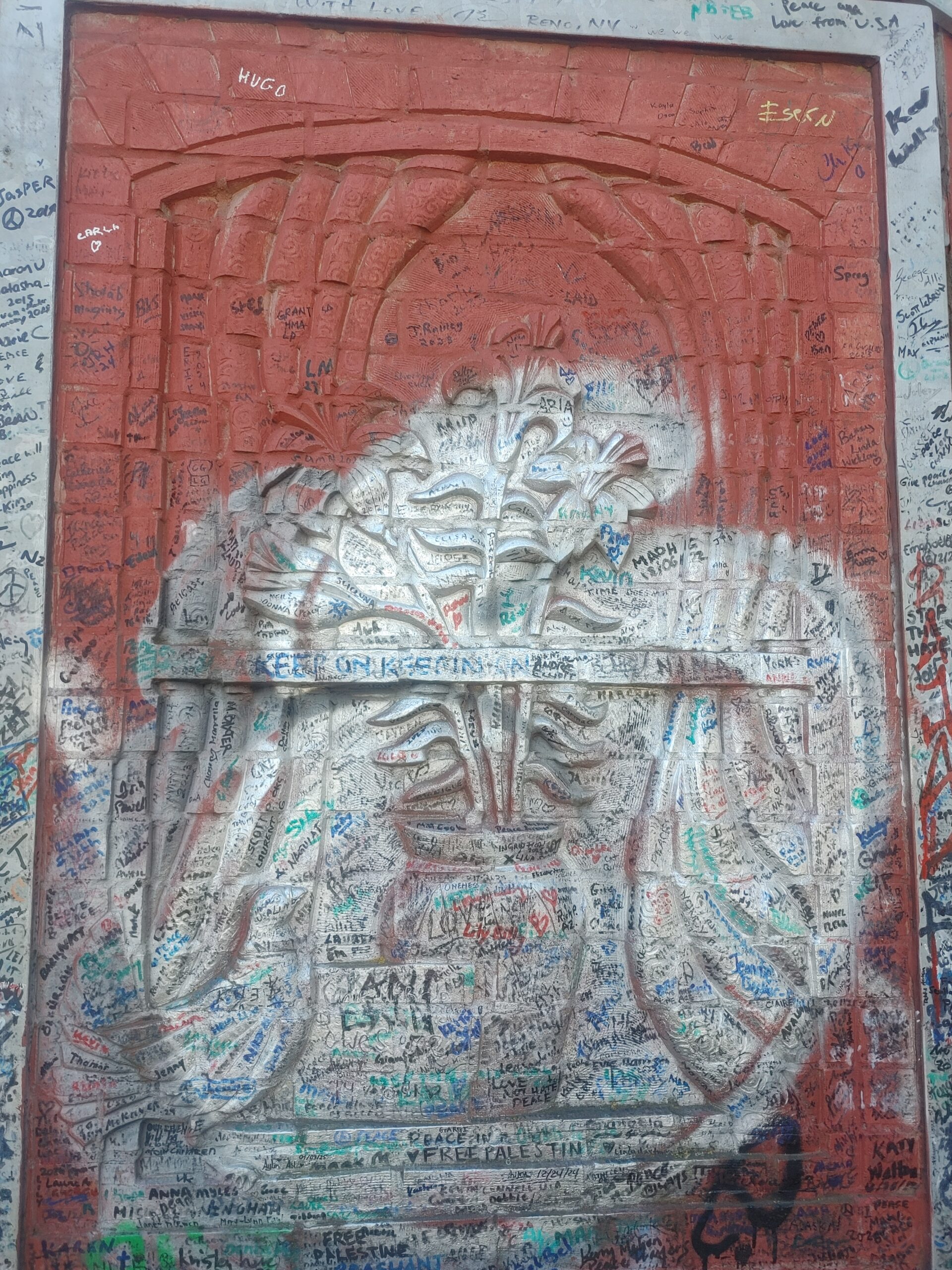
We ended our visit at the Peace Wall, covered in signatures, slogans, and pleas for unity or liberation—”Free Palestine,” “Free Northern Ireland,” messages scrawled over decades. I added my name in pencil. The sheer height of the wall startled me. And the fact that it still closes every night? That was haunting. A literal barrier still dividing people—not in memory, but in daily life.
Standing there made me reflect on how deeply separation shapes both individual lives and national narratives. Perspective changes everything, and being in Belfast made me realize just how much I still have to learn.