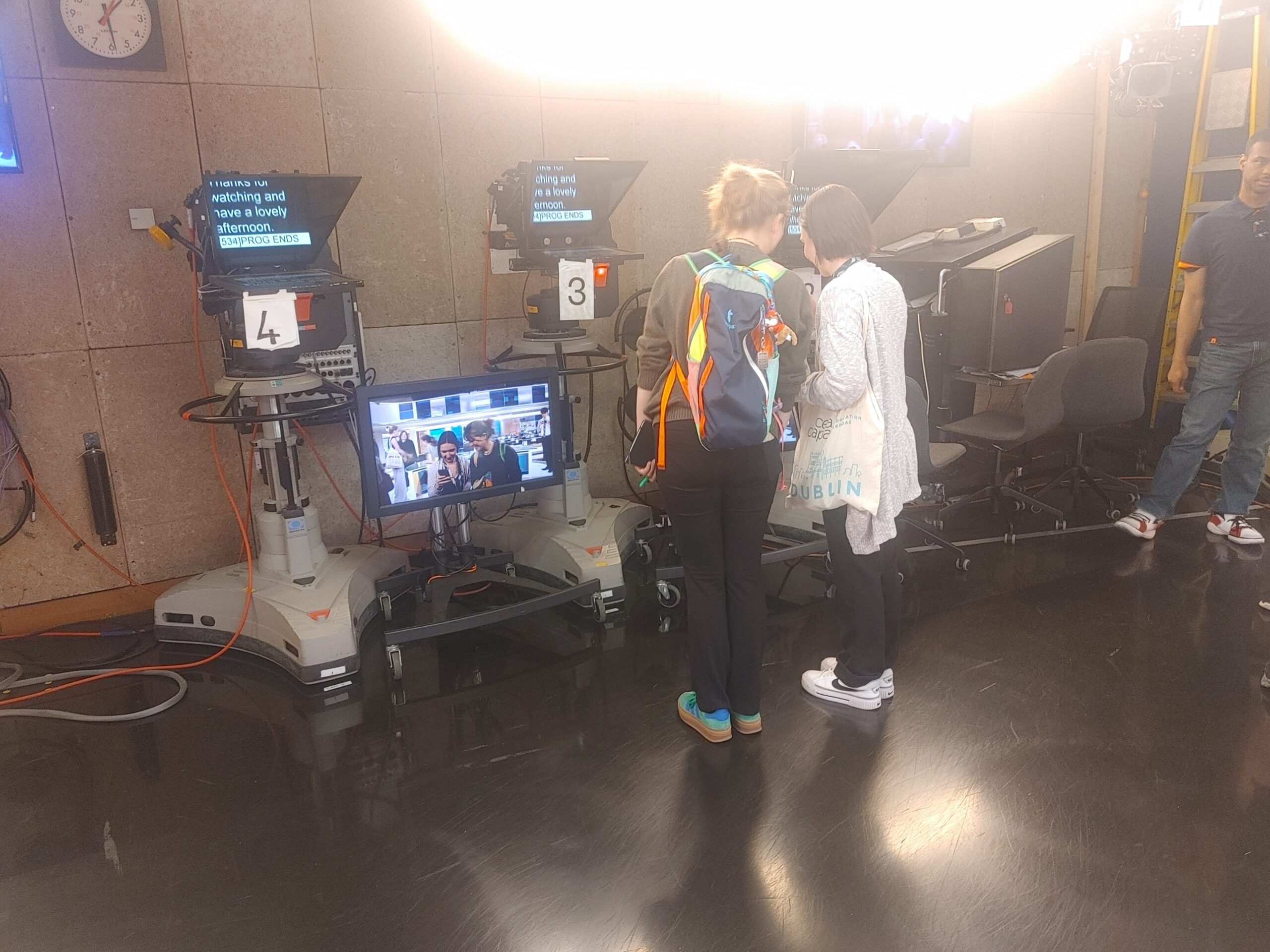
Today’s visit to RTÉ (Raidió Teilifís Éireann) was a deep dive into the world of Irish broadcasting—and honestly, it felt like stepping into a live heartbeat of the country’s media. From the moment we entered Studio 3, it was clear how much coordination and precision goes into every second of a broadcast. Our guide, Trevor, gave us a fast-paced, thorough breakdown of everything from the news bulletin structure to how the live visuals are stitched together by a visual mixer named Noelle.
One of the first things I noticed was the sheer number of screens—each monitor showed a different camera feed, timing countdown, or editorial control interface. There was a kind of choreography between the news coordinator, who manages the digital roadmap (“iNews”), and the camera operators, who balance wide shots, automated movements, and manual tracking.
I was particularly fascinated by how the teleprompter sits over the camera lens. That invisible barrier between script and spontaneity struck me as an actor—how these anchors are able to make a scripted line feel off-the-cuff and grounded. It’s a kind of performance, and it’s a skill.
We also learned from speakers like Brian Dowling and Brian O’Donovan about RTÉ’s commitment to impartial reporting. Dowling emphasized that news must remain objective, despite how difficult it can be when even the choice of what to report can imply bias. I found this ethically complex, especially when discussing elections or conflicts—how can full neutrality exist in a medium shaped by framing and selection?
Another topic that stuck with me was the balance between freedom of expression and protection of the public. RTÉ must weigh privacy, child protection, and avoid undue harm—like avoiding footage that could trigger seizures or traumatize viewers—while still reporting the truth.
One example shared involved a past broadcast that muted a racially insensitive term from an old film without fully confronting it, which led to a statutory complaint. I appreciated that the public has a channel to hold media accountable.
What surprised me most, though, was the creative tension between structure and improvisation. There’s room for spontaneity—anchors might add a personal touch beyond the script—and sometimes segments get cut off live, which raises questions about what’s pre-recorded vs. broadcast in real-time.
As someone interested in both media and acting, I left thinking about how much this world overlaps with performance—only with much higher stakes for truth and public trust; But there’s no reason those stakes shouldn’t exist with entertainment and art.