History Beneath Our Feet
Today, we joined a historical walking tour of Dublin led by a guide named Dara (like Derry, but without the “e,” he said with a smile). Dara was the kind of guide you hope for—passionate, clear, and confident, with the kind of Irish dialect that’s perfect for practice.
He walked us through centuries of Irish history with ease, tracing the city’s evolution from its Viking roots to the complexities of British rule. One highlight was learning about the Dubh Linn, or “black pool,” which gave Dublin its name. Strategically used by the Vikings, the site eventually evolved into what we now know as Dublin Castle.
Symbols and Struggles
We also passed by Trinity College, which historically was a Protestant institution—controversial in a divided Ireland—and stood before the grand former courthouse, now a bank, across from a statue of a harp-bearing woman gazing down in symbolic judgment.
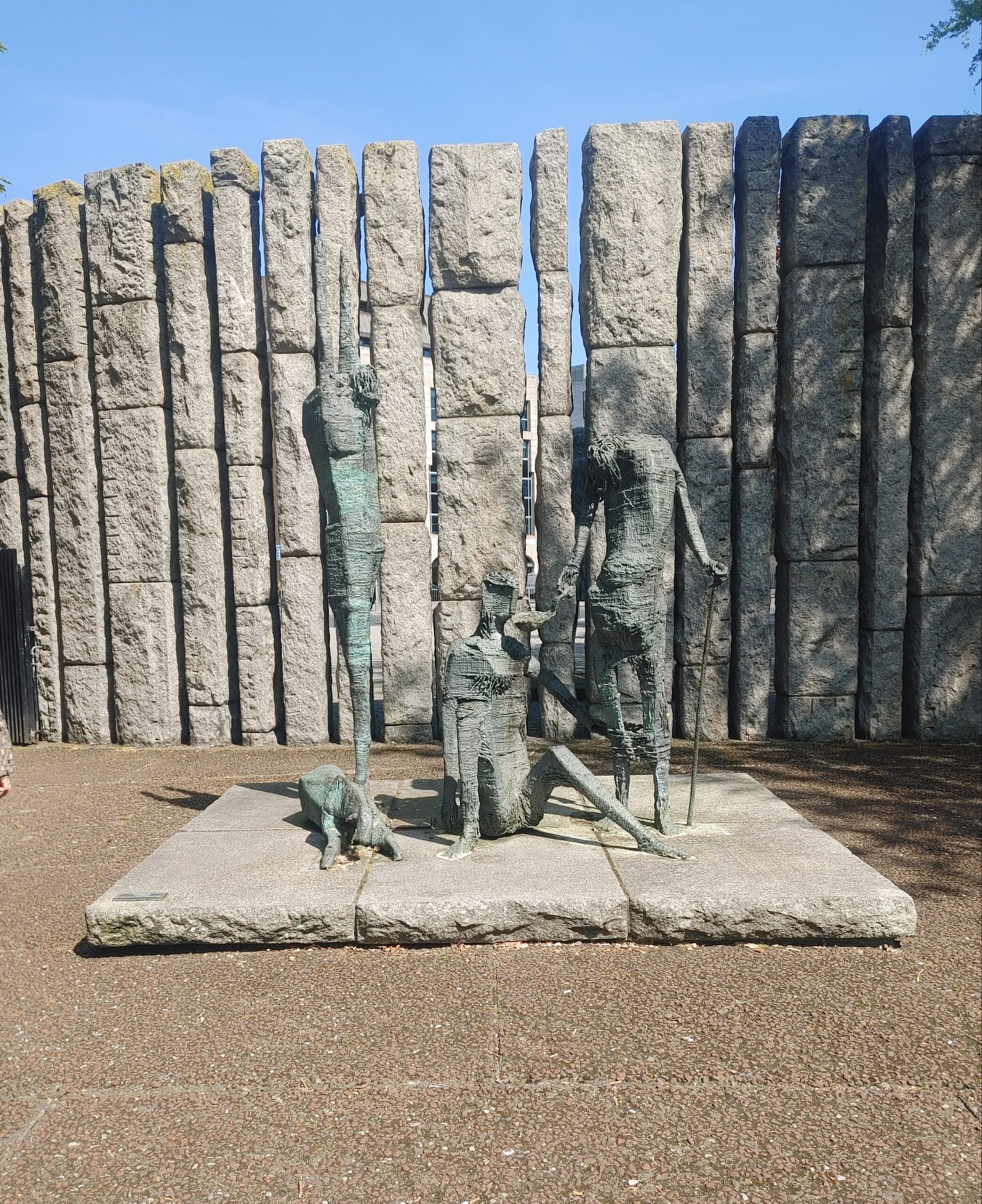
Dara touched on the waves of famine that shaped Irish identity and culture, pointing to a haunting sculpture of faceless figures sharing soup. Their anonymity conveyed a loss of humanity in a time of deep suffering. We ended at the statue of Wolfe Tone, remembered not just for his politics but for how he’s been reinterpreted by different generations.
His rebellious legacy lives on in many forms—some contradictory—and that, to me, is exactly how legacy should work.
Jigsaw
After the tour, I wandered through Grafton Street and grabbed some gelato before seeing my first play in Dublin: Jigsaw at the Glass Mask Theatre.
This tiny venue, tucked behind a café, felt incredibly personal. The two-man show followed a recovering addict grappling with grief, relapse, and redemption. One of the most powerful moments was a plot twist involving a dealer, an ex-wife, and the harsh realities of sobriety.
But the real brilliance was how the actors moved seamlessly between past and present, embodying multiple characters without ever losing clarity.
Empathy Over Escapism
What struck me most about Jigsaw was the way it told a story about people, rather than trying to create a new world. It wasn’t about spectacle—it was about presence. Each character was vivid and emotionally honest, making it easy to follow even as the timeline jumped around.
It reminded me that Irish theatre doesn’t lean into fantasy as much as it leans into truth. It invites the audience to witness pain, joy, humor, and failure in all their raw forms—not for entertainment, but for understanding. And that, to me, is storytelling at its most powerful.